
Linear Thinking
- Sumeet Pradhan
- Jul 20, 2022
- 4 min read


Many of us, who are regular social media users, might have stumbled upon “maths” puzzles, in one form or another, similar to the one above. Few of us might have tried to quickly solve it (and even gone to the extent of posting the answer!) to get a reassurance that our grey cells are still functional. Never mind that these school level puzzles, forget genius, are not even adequate to check basic aptitude. But they do test and reaffirm one fundamental human attitude: the penchant for linear thinking.
Most of us would answer the above puzzle as 6 or some number close to it. Hardly anyone would fancy 100 as the answer. The puzzle does not give any context or premise and yet people jump to assume the context without even being conscious that they are making the assumption. Human mind looks for the simplest possible pattern and then linearly extrapolates the pattern to fill in the blank. So natural is this tendency that the puzzle such as above does not even need to explicitly mention that such a linear pattern finding is being desired.
What if RHS of the above puzzle is some vital stats measurements of a patient with LHS being the waiting time in hours before she gets a hospital bed? And may be the stats below 15 is fatal. In such a case, the patient would be dead before waiting time reduces to 3 hours. Or what if the above numbers are frequency response measurement with a resonance frequency lurking around 3? The number 100 could be a realistic answer to this scenario.
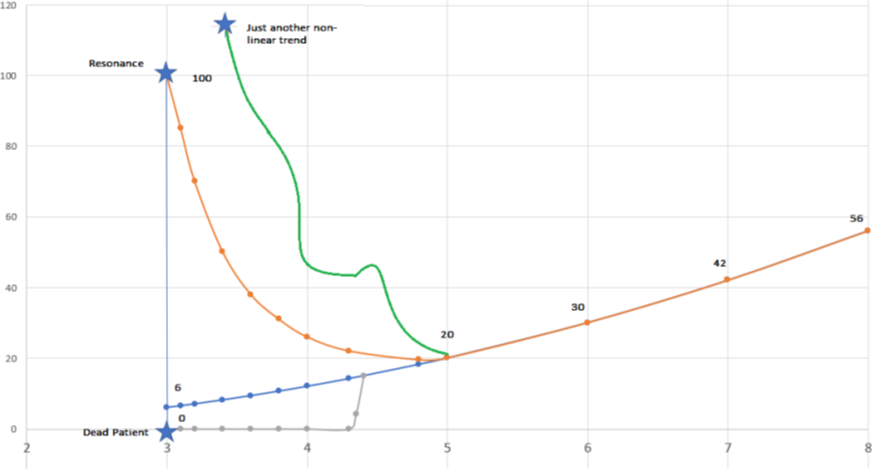
By linearity, I am not just talking about linear straight-line extrapolation. Extrapolating with aid of any well-known pattern involving few parameters is also some kind of linear thinking. Polynomial, exponential, logarithmic; all can be considered part of generalized linearity. But not many appreciate this generalization of linearity. Few days back I was reading a book called “The Signal and The Noise” where the author thinks that non-linearity means exponential! I don’t want to go mathematical but exponential function is the solution of one of the simplest linear dynamic systems.
Linear thinking probably has its origin in the way humans have evolved. For major part of species existence, humans as hunter gatherers roaming around in Savanna, were just one among millions other species with nothing special about us. The impact they were able to make to their habitat were like small perturbations that could be easily captured with linearized mental models. The trees that a tribe would manage to clear on its path would grow back even before the same tribe retrace its path back to the same location. The game of mammoth that they would hunt one summer would spring back to its original population size in a year.
Systems behaving non-linearly were mostly at a time scale beyond an individual’s perception or were too rare to make an impact on life. In any case, they were not anthropogenic and mostly outside of human control. Even the tools and artifacts made were simple enough to behave as simple extrapolation of the environment observed by the individuals.
But things have changed fast. Human impact has grown exponentially. The anthropogenic impact on the world can no longer be considered as mere perturbations. The scale at which hunter gatherer started hunting mammoths ensured that the woolly cousins of elephants would go extinct. The rate at which modern urban population is sucking ground water means that linear addition and subtraction of water to the water table is no longer valid as the aquifers are getting permanently squeezed.
There was a time until recent history when it was sufficient for the concerned experts to take cognizance of human’s linear thinking tendency. They needed to take it into consideration to design, control and/or monitor complex systems that would keep propelling human society. Whether ensuring a safe flying aircraft or assess the rise and fall of stock market, experts had to train their brains for non-linear thinking.
In 21st century, it is not sufficient that the burden is limited to the experts. In this age of materialism and globalization, from politics to climate change, action of almost every individual has impact on many aspects. And it is an ominous sign if common man is not well informed about her actions. A few days back, some “finance guy” in Linkedin, to justify India’s growth under the Supreme leader, posted that every 1 rupee increase in Indian GDP amounts to effective 3 rupees as PPP ratio of India is about 3.0. And people are falling for this linear thinking fallacy and further strengthening the modern-day bhakti movement. PPP ratio is not a constant. As countries get richer, PPP ratio too goes down.
And then there is this issue of climate change. The biosphere is an equilibrium with some built-in homeostasis. But human induced climate change is causing a complex chain of non-linear alterations that common man with finding hard to fathom. The linear thinking tendency would induce arguments such as: “If CO2 is a greenhouse gas that heats up the atmosphere, then how come its increased emission is causing floods or more extreme winters?”, “If the average temperature goes up 1 deg C, then it will only cause some little more inconvenience in the summer”, and so on.
So, what is the point I am trying to make with all this? Just a very simple thing. Always keep this linear thinking fallacy in mind. It will certainly help shaping your critical thinking. Next time if you stumble upon the puzzle mentioned above, do not fall the implicit linear assumption constraint. Choose your “correct” answer as you like. In recent times, my answer to such problem is mostly 1512.



Comments